.svg)
.svg)


Europe's Power Play
.png)
.svg)
.svg)
Europe was the birthplace of the Industrial Revolution, yet its grip on the industries that define global power is slipping. Natural gas import dependency sits at 85.6%. Manufacturing has fallen to 14.3% of EU GDP, well below the bloc's 20% target. Europe's share of global data centre capacity has dropped from over 25% in 2015 to 15% today.
Power rests on five foundations: economic prosperity, energy abundance, industrial capacity, technological leadership, and national security. Europe is losing ground on all five. Reversing that comes down to strengthening four power-critical sectors: energy, industry, critical materials, and compute. Decarbonising Europe runs through the same four sectors. Strategic autonomy and climate action converge on the same companies, the same technologies, the same capital allocation.
Under existential competitive pressure, European incumbents are moving into an aggressive buyer position, the strongest demand signal for deep tech the continent has seen in a generation. For investors, it opens a $35 trillion opportunity that will define the next decade of returns.
This report, with contributions from Kaya Partners and the NATO Innovation Fund, lays out where Europe is losing, what the opportunity looks like in numbers, and what investors and policymakers have to do in the next decade to close the gap.
Full report available <span style="color: #4F2780 !important; text-decoration: underline !important;">here.</span>
The power deficit
Europe's current position is the result of choices. Incremental innovation was prioritised over technological leadership. In 2025, BYD alone produced more battery electric vehicles than the entire European automotive industry, the birthplace of the automobile.
Cheap Russian gas, outsourced manufacturing in China, and reliance on the American security umbrella were all consequences of optimising for efficiency over self-sufficiency. Russia's war in Ukraine, China's tightening control of critical supply chains, and renewed instability in the Middle East have made those choices impossible to defend.
The debate in Brussels has centred on resilience. Resilience is reactive by design. The conversation needs to move on from how we absorb the next shock to how we rebuild the power base that prevents it.
Europe has to compete across four power-critical sectors: energy, industry, critical materials, and compute. All four are multi-trillion-dollar markets undergoing profound change.
"European deep tech has been sold as a strategic story for too long. It's a returns story. The $35 trillion sits in front of us, the companies are being built, and the investors who back them now will own the outcomes."
- Daria Saharova, Managing Partner, World Fund
A $35 trillion opportunity
The alignment between strategic need and commercial return is clear. Clean energy generation cuts emissions, anchors cheap supply, and lowers exposure to global commodity shocks. Battery recycling reduces virgin mining, cuts the carbon footprint of materials, and breaks China's grip on supply. The same technology solves multiple problems.
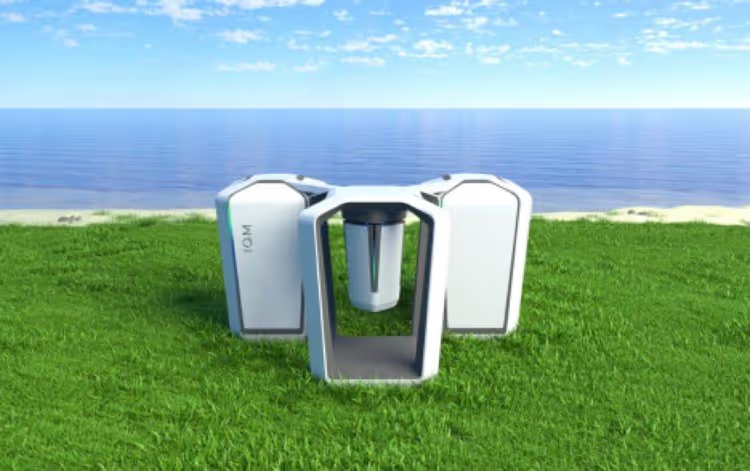
The commercial evidence is already in the market. Octopus Energy has reached a $9 billion valuation and spun out its Kraken platform for $8.7 billion. IQM Quantum Computers is going public at $1.8 billion, the first European quantum company to list.
European incumbents are acting as urgent buyers for solutions. Porsche and Bosch invested in cylib, Airbus invested in Quantum Systems and SAP partnered with Mistral. Each of these moves is a corporate balance sheet voting for European deep tech under competitive pressure.
"Venture and growth capital are central to whether Europe can strengthen its industrial base, maintain climate leadership and build real economic and strategic resilience."
- Bo Lidegaard, Partner, Kaya Partners
If Europe acts, the next decade produces a generation of category-defining companies anchored domestically, an industrial base that matches its climate ambition, and the technological leverage to shape events rather than react to them.
The $35 trillion is already in front of us. The companies are being built. The question is who finances them.
For an closer look at the policy landscape, please see the Kaya Partners Policy section here.
Read the full report below.






.svg)
.svg)
.svg)