Knowledge

A new source of power: solar from space

A new source of power: solar from space

Nearly 60 years after it was first proposed, space-based solar power is attracting private capital and its first commercial commitments. Power beamed from orbit could reach any site on Earth with land for a receiver, without a grid connection or a fuel supply. Whether that becomes a business depends on a short list of assumptions, and nobody has yet shown that they can all hold at once. This is our view of what they are, how realistic each one is, and what we want to see from the companies working on them.

In 1941, Isaac Asimov imagined a space station that collects sunlight and beams the energy down to Earth. In his short story Reason, a robot runs the station and refuses to believe Earth exists. Twenty-seven years later, Peter Glaser turned the fiction into an engineering proposal. In 1968, he proposed in Science collecting sunlight in orbit and beaming it to Earth, and he patented the design in 1973.

Figure 1: Peter Glaser, who proposed space-based solar power in Science in 1968, with a model of a satellite orbiting Earth, next to the covers of Isaac Asimov's Reason (1941) and Ralph Nansen's Sun Power

Space-based solar power (SBSP) collects solar energy in orbit and beams it as microwaves or laser light to receivers on Earth or other spacecraft, which convert it into electricity. These applications serve different customers and face different engineering challenges. This article covers both, with a focus on space-to-Earth (the space-to-space segment had a much less certain set of assumptions on the market size).

If it works, SBSP can put clean power almost anywhere, day or night. A site needs land for a receiver, but no grid connection and no fuel supply, so SBSP can compete with any power source on the ground and avoid grid bottlenecks. It matters most for defence, backup power, remote sites where the grid is unreliable and places the grid cannot reach fast enough, where even a price well above grid power can win. It can also power satellites in orbit. The challenge is delivering enough of it, reliably and at a competitive price.

Why now

Reusable launch has transformed space economics. The Space Shuttle used for the International Space Station cost approximately $54,500/kg to reach low Earth orbit, compared with around $2,700/kg for Falcon 9 and $1,500/kg for Falcon Heavy. Starship's proposed $100–150/kg remains a target, but it is no longer out of reach.

The tech is beginning to be proven. In 2023, Caltech's SSPD-1 mission tested solar cells, a deployable structure and a microwave beaming array in orbit. In 2025, DARPA transmitted more than 800 W of laser power over 8.6 km in a 30-second ground-based demonstration.

Surging demand for power across all sectors, driven mostly by data centres and decarbonisation, needs firm power in places the grid cannot reach or deliver fast enough. The IEA expects data centres alone to use about 1,200 TWh a year by 2035, half of all additional grid requests are coming from data centres desperate for power today; the grid queues are getting longer and longer, extending to over 6 years for new capacity. 

Space based solar is one candidate, and investors are responding. Star Catcher raised a $65 million Series A led by B Capital to sell power between satellites. Overview Energy raised a $20 million seed round from Lowercarbon and Prime Movers Lab, and Reflect Orbital raised a $20 million Series A from Lux Capital and Sequoia. Aetherflux raised $50 million in 2025 to develop space-based solar power, then rebranded as Cowboy Space and raised $275 million last May. Its focus has expanded to include launch vehicles and orbital data centres.

What is SBSP, and why is it so hard to build

In a space-to-Earth system, solar arrays in orbit generate electricity, and a transmitter sends it to the ground as microwaves or laser light. A microwave beam lands on a rectenna, a large field of antennas that converts it back into electricity. Laser systems use photovoltaic panels instead.

Figure 2: How space-to-Earth solar power works, from collecting sunlight in orbit to delivering electricity to an end user 

For decades, SBSP has referred to gigawatt-scale plants in geostationary orbit (GEO), where satellites stay above the same point on Earth and receive sunlight almost all year. NASA's assessment puts a 2 GW plant at more than 14 times the mass of the International Space Station. High upfront costs, slow progress, and long timelines have pushed developers towards other designs.

Figure 3: Four gigawatt designs proposed between 2014 and 2023, drawn to one scale, next to the ISS and the tallest buildings on Earth. Structures simplified; SPS-ALPHA and Thales show published areas in an assumed layout (Sources: World Fund analysis based on Barde, IEEE Spectrum (2024), NASA OTPS (2024), Cash (2018), Hou (2024), NASA)

Newer designs split the plant into smaller pieces, in one of two ways. Modules can be assembled in orbit into one large plant, or a constellation can spread the capacity across many separate satellites. Lower orbits shorten the distance the beam travels, but a satellite there spends less time above a given receiver. Sustained service then needs a constellation, so another satellite can take over as each one moves away.

Figure 4: The orbit sets how far the power must travel and how long a satellite stays over one site; the design sets how big the first step is (Source: World Fund analysis)

The destination of the power also shapes the technology. Space-to-space systems supply satellites or lunar assets, which need less power and suit compact laser receivers. Space-to-Earth systems move far more power, and most use microwaves, which pass through clouds and rain with little loss, while clouds absorb or scatter laser light. Overview Energy is one exception and plans to beam near-infrared light onto existing solar farms.

Can electricity from orbit compete on cost? 

Not on the grid, and not yet. NASA puts space solar power at 12 to 80 times the cost of terrestrial alternatives per unit of electricity. In Caltech’s comparison, utility solar costs about $44/MWh and gas peaking plants about $169/MWh. Off-grid, the price is higher: the US Army pays about $400/MWh for power at its Arctic installations. That is where the first sales are most likely.

NASA's 2024 assessment estimates electricity costs of $610–1,590/MWh for its two reference designs. A UK government-commissioned study projects £335–595/MWh for a first-of-a-kind system in 2030, falling to £87–129/MWh for a mature plant in 2040. Caltech's model reaches $94/MWh after another decade of technological development. These estimates describe different systems, assumptions, timelines, and financing conditions, making direct comparisons difficult but they show what could be possible.

Launch is only one input. Satellites need to become lighter and cheaper to manufacture, transmission losses must fall, and equipment must operate reliably for decades. NASA's most optimistic scenario reaches $30–80/MWh only when several (almost all) favourable assumptions are combined.

Financing matters as much as hardware. In the UK study, a lower cost of capital alone cuts the cost of electricity by 42%. Unlike terrestrial solar, an SBSP plant requires substantial investment before delivering its first electricity.

For investors, the immediate question is whether smaller systems can generate revenue before the economics of utility-scale electricity are proven. Diesel sites can pay for the first systems, but each needs only megawatts, and there are few of them. To return a venture fund, a company has to reach the next tier, data centres and other grid-constrained sites, where demand runs to gigawatts.

Who will buy power from space first?

The first customers will be those who pay for access to power where alternatives are expensive or unavailable. Two markets stand out: satellites that need more energy than their onboard solar arrays can provide, and terrestrial sites that depend on costly fuel deliveries.

In space, additional power could extend satellite lifetimes or increase computing capacity without adding larger solar arrays and batteries. Star Catcher reported seven commercial power purchase agreements by May 2026 and demonstrated 1.1 kW of optical power transmission on the ground. Its first orbital mission launched in October 2026, although commercial power delivery remains unproven.

On Earth, remote mines, islands and military installations could justify higher electricity prices than national grids. This offers a potential first market for space-to-earth transmission, provided the technology can compete with diesel generation and other local alternatives.

Meta has reserved up to 1 GW from Overview Energy, tied to a 2028 orbital demonstration, and Virtus Solis has signed a 20-year PPA with Brae Systems for 100 MW. But commitments are not proof of delivery. History provides a warning: Solaren (US) signed a 200 MW power purchase agreement with PG&E in 2009, promising electricity by 2016. The project never delivered, and the contract was dropped after financing failed. 

The climate case

SBSP’s climate value depends on the energy it replaces, and the first buyers replace the most carbon-intensive power there is. Diesel generators emit about 0.8 tonnes of CO₂ per MWh, more than three times the 0.24 tonnes of the 2035 grid in the IEA’s Stated Policies scenario. A gigawatt of space power delivered over a year would avoid close to 6 Mt of CO₂ at diesel sites, against 1.7 Mt on the grid. At full potential, SBSP supplies the firm power that gas and coal still provide to grids and data centres. The IEA expects data centres to use about 1,200 TWh a year by 2035, which at the 2035 grid mix is roughly 290 Mt of CO₂ a year (but given the grid constraints a lot of this could be from gas generators, see our other report on LDES).

Space-to-space power follows a different logic. Its climate value depends on how much power use moves to orbit, on which applications cheap power in orbit enables, and on how many launches it saves. A satellite that buys power on demand can carry less solar array and battery, and launch is the largest source of emissions (64 to 72%) in NASA’s lifecycle estimate for space solar power.

What has to be true

The design in orbit matters technically, but SBSP will succeed or fail on what it delivers on Earth. It has to deliver enough power where customers need it, at a price that beats their local alternative. For early customers at remote sites, that alternative is diesel.

Several parts of SBSP already work on their own. Space-grade solar cells convert 30–34% of sunlight into electricity, compared with about 24% for commercial solar panels on Earth. In orbit, Caltech's MAPLE array beamed about 0.25 W to receivers inside its own spacecraft, and its signal was detected on Earth. Nobody has yet delivered sustained, useful, (cost effective) power from orbit to the ground. For that, six things have to hold:

  1. Launch must cost $500/kg or less. NASA's cost-competitive case assumes that price, a third of Falcon Heavy's today. On the trend of the past decade, NASA still expects about $615/kg in 2040. Within the next decade, only SpaceX looks able to launch at the volume a fleet of power satellites needs, and it has its own priorities, such as Starlink. SpaceX charges about $74 million for a Falcon 9 launch, but launching its own Starlink satellites costs it about a fifth of that. An independent SBSP company would pay list price for every launch, while one owned by SpaceX would launch at cost, making SpaceX a likely buyer of whoever proves the technology or a possible competitor able to undercut on costs.
  2. Solar arrays must become lighter and cheaper. Typical spacecraft arrays produce about 30 W/kg, and the best reported designs about 200 W/kg. The cells alone cost $250–450 per watt, and prices for complete arrays are not published. Participants at a 2026 US Department of Energy workshop set a 2035 target of more than 200 W/kg at under $10 per watt for the whole array. Arrays also have to survive radiation for years and be built in volume.
  3. Wireless transmission must work. This is likely the most difficult engineering challenge. Microwave beams spread through diffraction, making transmission distance, frequency and aperture size critical. Large systems rely on millions of antenna elements operating in phase to direct energy towards a receiver. A gigawatt design in geostationary orbit needs a transmitter about 750 m across, holding millions of antennas. In principle, this is a computing and control problem, but accurate pointing and phase synchronisation across structures of this size have never been demonstrated.
  4. At least a third of the power generated in orbit has to reach the grid. The system designs we reviewed assume 33–40%. The best end-to-end result on record is 54%, measured by JPL and Raytheon in a laboratory in 1975. End-to-end efficiency has never been measured from orbit, as first orbital demonstrations are planned for 2027–29.
  5. Orbital assembly has to be robust and automated. The International Space Station spans 109 metres and was delivered over 42 assembly launches, with more than 260 spacewalks subsequently supporting its assembly, maintenance and reconfiguration. NASA's reference SBSP designs would weigh thousands of tonnes and extend over several square kilometres. Constructing and maintaining such systems autonomously would require capabilities that have not yet been demonstrated. Smaller, modular systems reduce this risk.‍
  6. Ground infrastructure and spectrum need to be available. The same ESA reference design requires more than 34 km² of receiving infrastructure. Alternative frequencies and architectures can reduce this footprint, but operators must still secure suitable land, spectrum allocation and safety approvals. 
Figure 5: International Space Station, the biggest structure ever built in space (Sources: World Fund analysis based on NASA, NASA OIG (2014), ESA, NASA OTPS (2024)) 

Until an integrated demonstration delivers sustained power from orbit with measured end-to-end efficiency, the economics of commercial SBSP remain theoretical 

Can Europe shape the future of SBSP

For Europe, SBSP is a question of strategic autonomy. ESA's SOLARIS programme has investigated its technical and economic feasibility, while European industry already has expertise in space photovoltaics, deployable structures and satellite engineering.

Other regions are moving towards demonstrations. The US combines private investment with defence-backed research, while China has proposed orbital tests and Japan continues to develop wireless power transmission. Europe has much of the technical foundation, but still faces a funding gap between research and commercial deployment.

This requires more than developing individual components. The ability to integrate solar arrays, wireless transmission, orbital structures, and ground infrastructure will be critical. Moving from research to orbital demonstrations will also require public funding and established industrial partners, as venture capital alone is unlikely to finance the earliest large-scale projects.

Where we see the opportunity

At World Fund, we believe SBSP must prove it can be a business in low Earth orbit (LEO) before any plan to move to massive structures in GEO. We look for companies that build world-class hardware, understand how energy is bought and sold, and can navigate a highly specialised aerospace ecosystem.

We need to see credible commercial demand, ideally through a priced agreement or paid pilot. Their cost models must account for realistic launch access, system mass, transmission efficiency, and the price customers are willing to pay. 

We remain cautious about projects requiring billions in capital before their first sale and components whose commercial opportunity depends entirely on SBSP succeeding. Large pre-commercial demonstrations may require public funding and established industrial partners rather than venture capital alone.

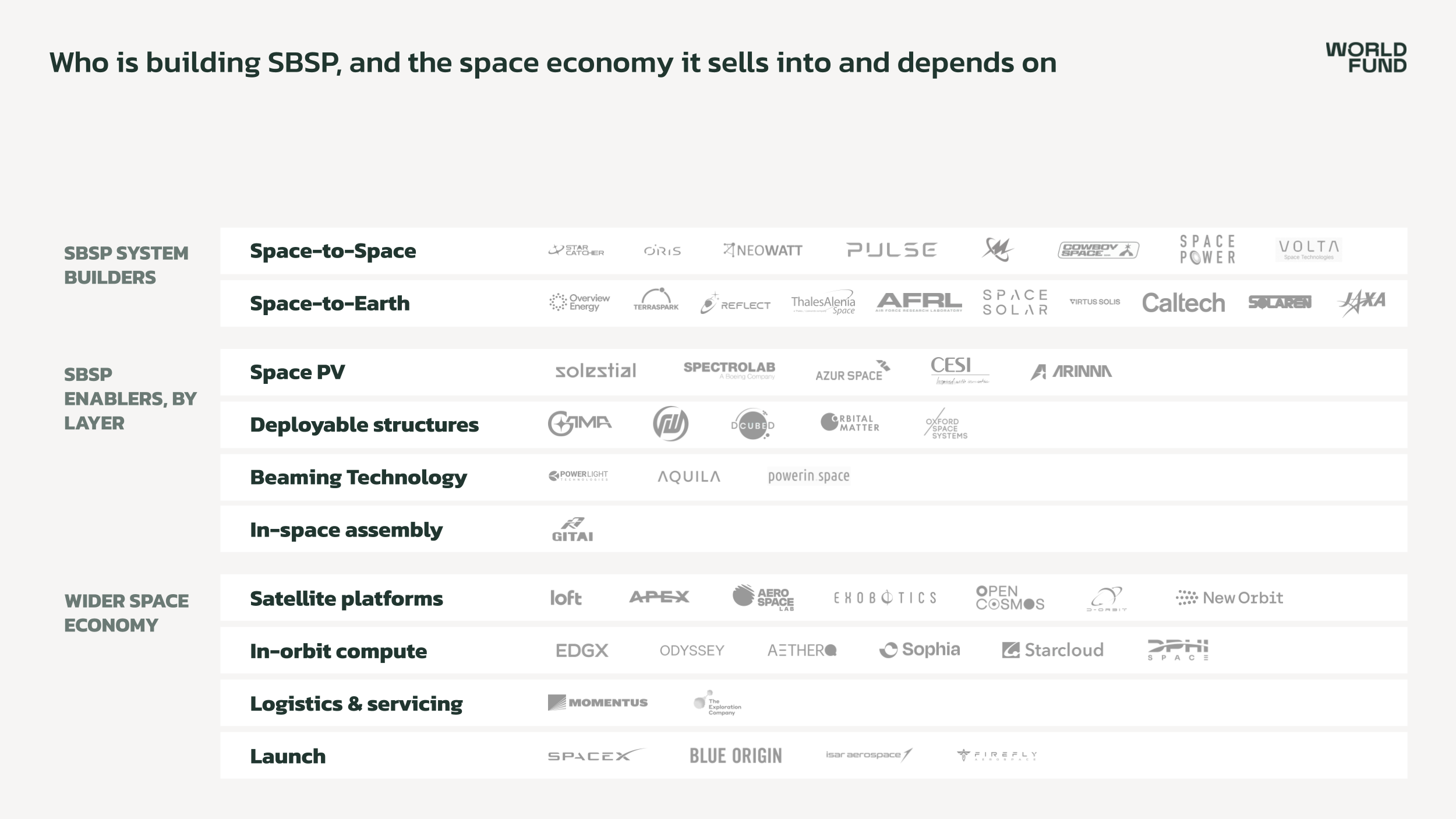
Power from orbit is a big opportunity with many assumptions that need to materialise for it to be successful. The ones listed in this article are the ones we should consider before getting excited. 

The bottom line

The question for space-based solar power is no longer whether it can be imagined, or even launched. It is whether every link in the chain can work at the same time: launch at $500/kg or less; solar arrays that are far lighter and cheaper; beams steered precisely at scale; at least a third of the power reaching the ground; assembly in orbit that runs itself; and land and spectrum on the ground. Each link has advanced on its own, but none has been shown working together, and today’s best cost estimates still put power from orbit above the price of diesel at a remote military base.

The first winners will close that gap with a smaller system in LEO that delivers measured power to a customer with no better option, long before anyone builds a gigawatt plant in GEO. The company that does this first will have turned a 60-year-old idea into an energy business. It will also be well placed to compete for the far larger market of data centres and grid-constrained sites.

If you are working on any link in this chain, or on finding the first paying customer, and you have results you can measure, please get in touch at robin@worldfund.vc and craig@worldfund.vc.

Daria Saharova, World Fund

Managing Partner

Craig Douglas, World Fund

Partner

craig@worldfund.vc

Robin Neff, World Fund

Principal

robin@worldfund.vc

Agustin Abrruzzese

Visiting Analyst

November 16, 2026

Why We Invested in Anaphite: the company reducing the cost of EV batteries by up to 10%

Read more

Europe’s state of climate VC — Slides for Planet Sustainability

Read more

How to measure the climate performance potential of startups

Read more
Knowledge

A new source of power: solar from space

|
White Paper

A new source of power: solar from space

Nearly 60 years after it was first proposed, space-based solar power is attracting private capital and its first commercial commitments. Power beamed from orbit could reach any site on Earth with land for a receiver, without a grid connection or a fuel supply. Whether that becomes a business depends on a short list of assumptions, and nobody has yet shown that they can all hold at once. This is our view of what they are, how realistic each one is, and what we want to see from the companies working on them.

In 1941, Isaac Asimov imagined a space station that collects sunlight and beams the energy down to Earth. In his short story Reason, a robot runs the station and refuses to believe Earth exists. Twenty-seven years later, Peter Glaser turned the fiction into an engineering proposal. In 1968, he proposed in Science collecting sunlight in orbit and beaming it to Earth, and he patented the design in 1973.
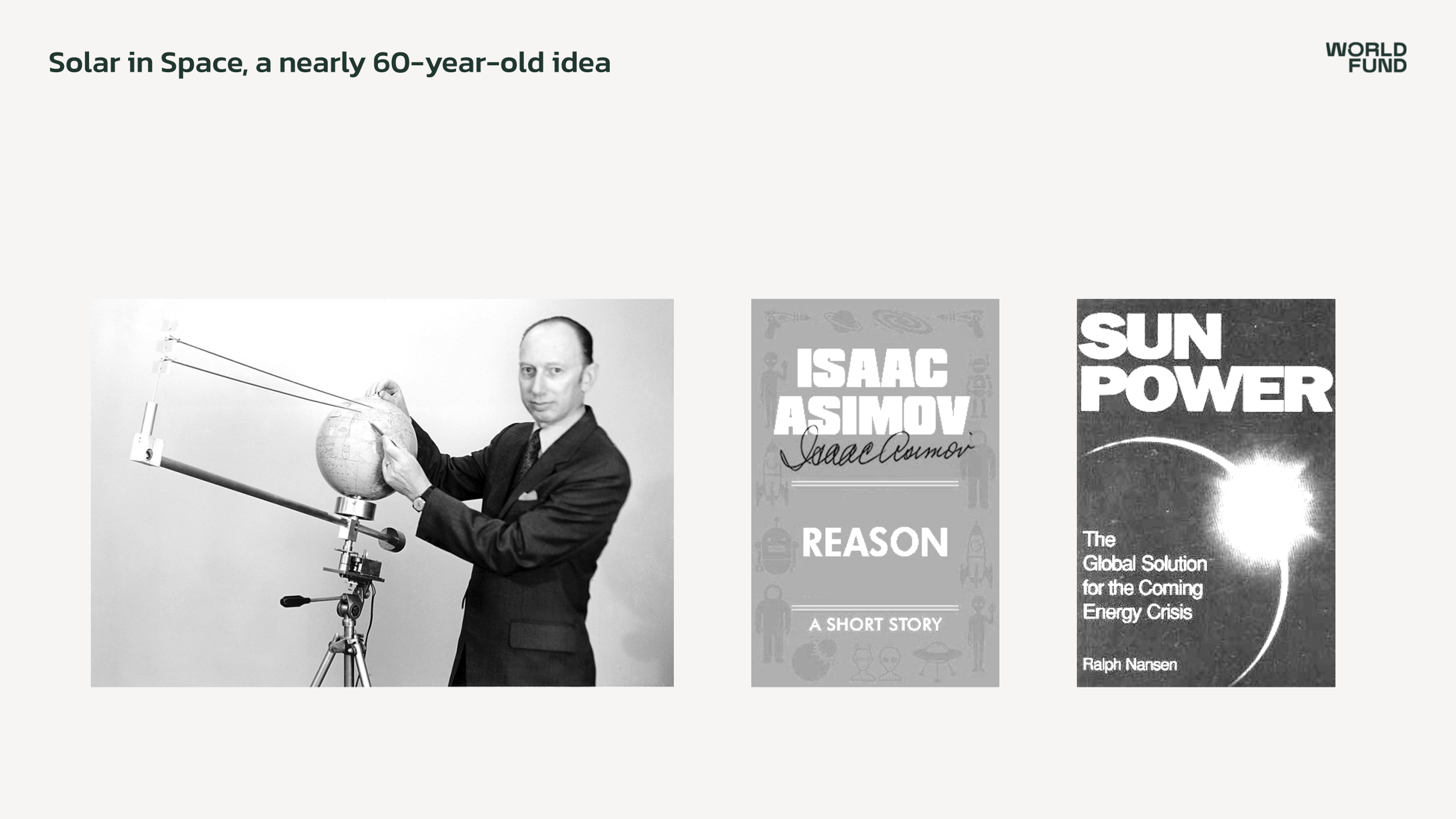
Figure 1: Peter Glaser, who proposed space-based solar power in Science in 1968, with a model of a satellite orbiting Earth, next to the covers of Isaac Asimov's Reason (1941) and Ralph Nansen's Sun Power

Space-based solar power (SBSP) collects solar energy in orbit and beams it as microwaves or laser light to receivers on Earth or other spacecraft, which convert it into electricity. These applications serve different customers and face different engineering challenges. This article covers both, with a focus on space-to-Earth (the space-to-space segment had a much less certain set of assumptions on the market size).

If it works, SBSP can put clean power almost anywhere, day or night. A site needs land for a receiver, but no grid connection and no fuel supply, so SBSP can compete with any power source on the ground and avoid grid bottlenecks. It matters most for defence, backup power, remote sites where the grid is unreliable and places the grid cannot reach fast enough, where even a price well above grid power can win. It can also power satellites in orbit. The challenge is delivering enough of it, reliably and at a competitive price.

Why now

Reusable launch has transformed space economics. The Space Shuttle used for the International Space Station cost approximately $54,500/kg to reach low Earth orbit, compared with around $2,700/kg for Falcon 9 and $1,500/kg for Falcon Heavy. Starship's proposed $100–150/kg remains a target, but it is no longer out of reach.

The tech is beginning to be proven. In 2023, Caltech's SSPD-1 mission tested solar cells, a deployable structure and a microwave beaming array in orbit. In 2025, DARPA transmitted more than 800 W of laser power over 8.6 km in a 30-second ground-based demonstration.

Surging demand for power across all sectors, driven mostly by data centres and decarbonisation, needs firm power in places the grid cannot reach or deliver fast enough. The IEA expects data centres alone to use about 1,200 TWh a year by 2035, half of all additional grid requests are coming from data centres desperate for power today; the grid queues are getting longer and longer, extending to over 6 years for new capacity. 

Space based solar is one candidate, and investors are responding. Star Catcher raised a $65 million Series A led by B Capital to sell power between satellites. Overview Energy raised a $20 million seed round from Lowercarbon and Prime Movers Lab, and Reflect Orbital raised a $20 million Series A from Lux Capital and Sequoia. Aetherflux raised $50 million in 2025 to develop space-based solar power, then rebranded as Cowboy Space and raised $275 million last May. Its focus has expanded to include launch vehicles and orbital data centres.

What is SBSP, and why is it so hard to build

In a space-to-Earth system, solar arrays in orbit generate electricity, and a transmitter sends it to the ground as microwaves or laser light. A microwave beam lands on a rectenna, a large field of antennas that converts it back into electricity. Laser systems use photovoltaic panels instead.
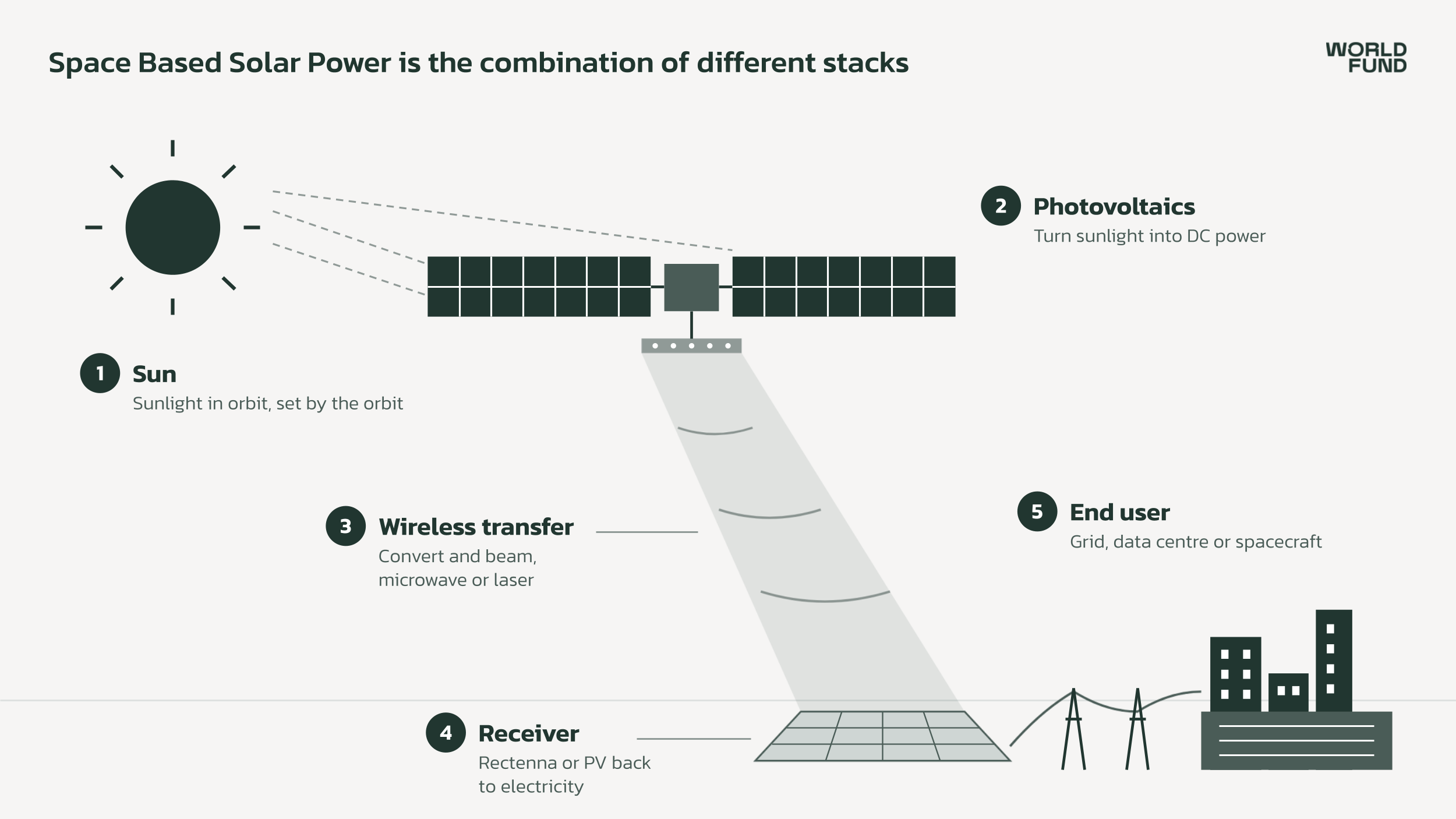
Figure 2: How space-to-Earth solar power works, from collecting sunlight in orbit to delivering electricity to an end user 

For decades, SBSP has referred to gigawatt-scale plants in geostationary orbit (GEO), where satellites stay above the same point on Earth and receive sunlight almost all year. NASA's assessment puts a 2 GW plant at more than 14 times the mass of the International Space Station. High upfront costs, slow progress, and long timelines have pushed developers towards other designs.
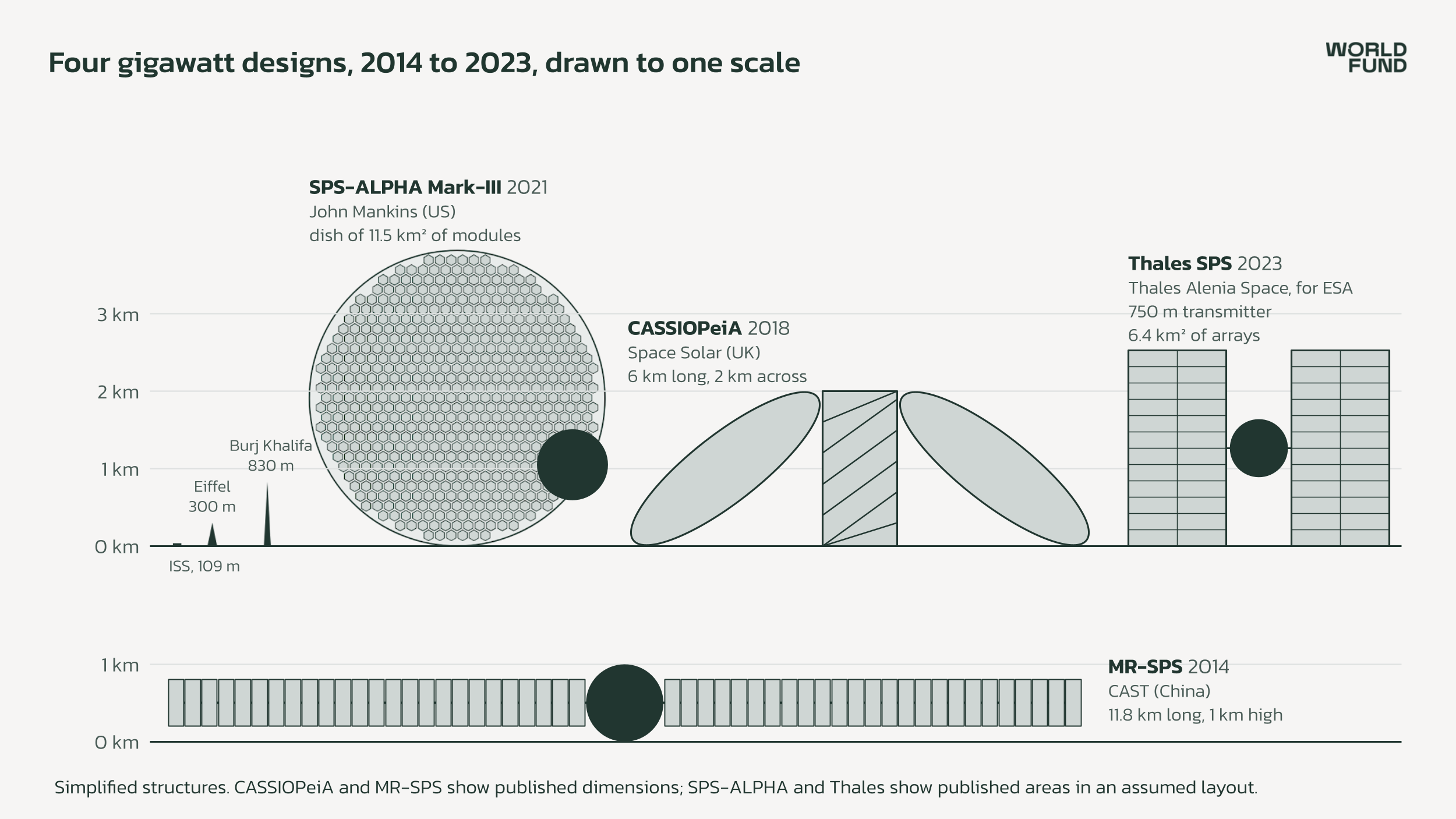
Figure 3: Four gigawatt designs proposed between 2014 and 2023, drawn to one scale, next to the ISS and the tallest buildings on Earth. Structures simplified; SPS-ALPHA and Thales show published areas in an assumed layout (Sources: World Fund analysis based on Barde, IEEE Spectrum (2024), NASA OTPS (2024), Cash (2018), Hou (2024), NASA)

Newer designs split the plant into smaller pieces, in one of two ways. Modules can be assembled in orbit into one large plant, or a constellation can spread the capacity across many separate satellites. Lower orbits shorten the distance the beam travels, but a satellite there spends less time above a given receiver. Sustained service then needs a constellation, so another satellite can take over as each one moves away.
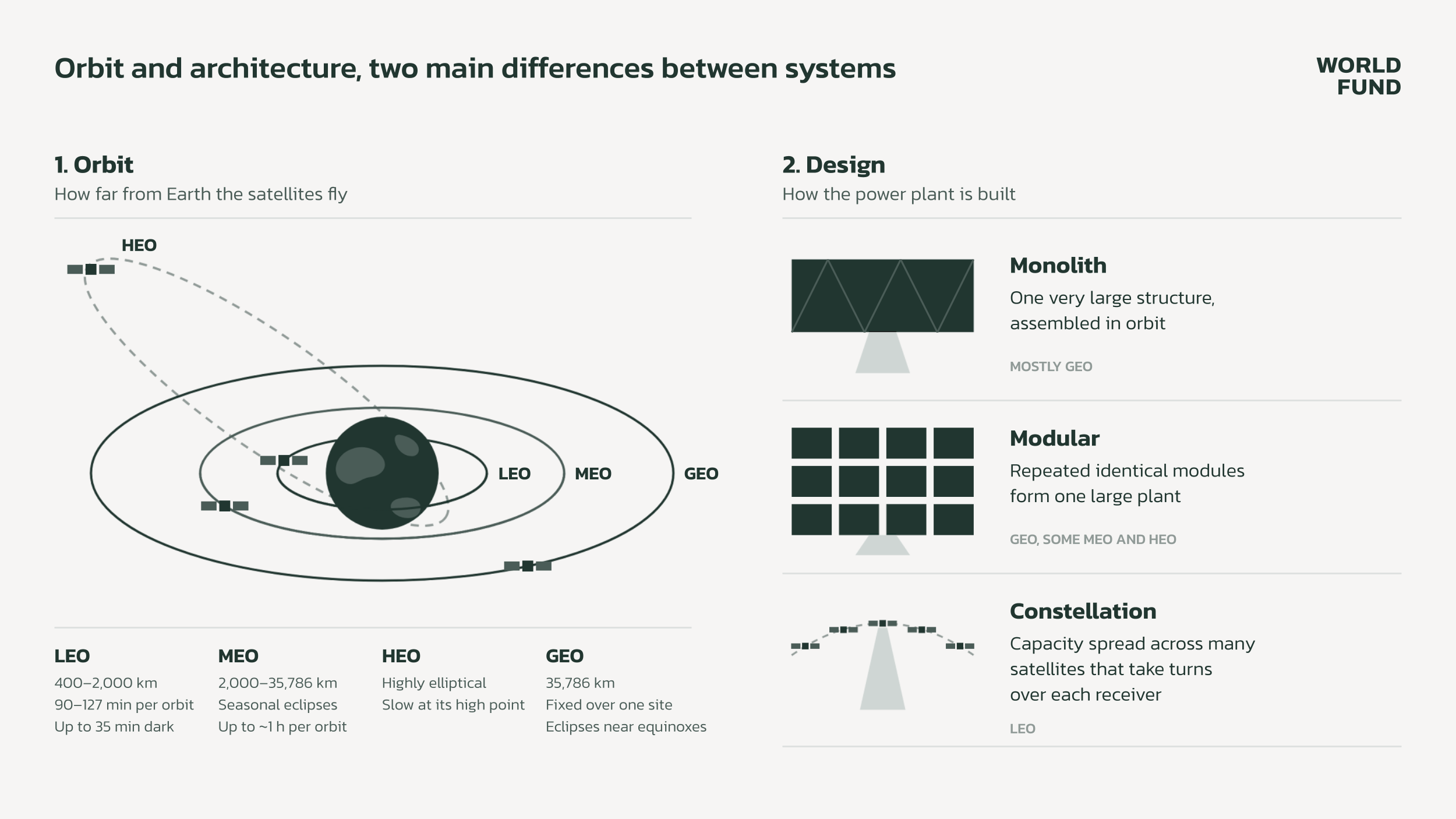
Figure 4: The orbit sets how far the power must travel and how long a satellite stays over one site; the design sets how big the first step is (Source: World Fund analysis)

The destination of the power also shapes the technology. Space-to-space systems supply satellites or lunar assets, which need less power and suit compact laser receivers. Space-to-Earth systems move far more power, and most use microwaves, which pass through clouds and rain with little loss, while clouds absorb or scatter laser light. Overview Energy is one exception and plans to beam near-infrared light onto existing solar farms.

Can electricity from orbit compete on cost? 

Not on the grid, and not yet. NASA puts space solar power at 12 to 80 times the cost of terrestrial alternatives per unit of electricity. In Caltech’s comparison, utility solar costs about $44/MWh and gas peaking plants about $169/MWh. Off-grid, the price is higher: the US Army pays about $400/MWh for power at its Arctic installations. That is where the first sales are most likely.

NASA's 2024 assessment estimates electricity costs of $610–1,590/MWh for its two reference designs. A UK government-commissioned study projects £335–595/MWh for a first-of-a-kind system in 2030, falling to £87–129/MWh for a mature plant in 2040. Caltech's model reaches $94/MWh after another decade of technological development. These estimates describe different systems, assumptions, timelines, and financing conditions, making direct comparisons difficult but they show what could be possible.

Launch is only one input. Satellites need to become lighter and cheaper to manufacture, transmission losses must fall, and equipment must operate reliably for decades. NASA's most optimistic scenario reaches $30–80/MWh only when several (almost all) favourable assumptions are combined.

Financing matters as much as hardware. In the UK study, a lower cost of capital alone cuts the cost of electricity by 42%. Unlike terrestrial solar, an SBSP plant requires substantial investment before delivering its first electricity.

For investors, the immediate question is whether smaller systems can generate revenue before the economics of utility-scale electricity are proven. Diesel sites can pay for the first systems, but each needs only megawatts, and there are few of them. To return a venture fund, a company has to reach the next tier, data centres and other grid-constrained sites, where demand runs to gigawatts.

Who will buy power from space first?

The first customers will be those who pay for access to power where alternatives are expensive or unavailable. Two markets stand out: satellites that need more energy than their onboard solar arrays can provide, and terrestrial sites that depend on costly fuel deliveries.

In space, additional power could extend satellite lifetimes or increase computing capacity without adding larger solar arrays and batteries. Star Catcher reported seven commercial power purchase agreements by May 2026 and demonstrated 1.1 kW of optical power transmission on the ground. Its first orbital mission launched in October 2026, although commercial power delivery remains unproven.

On Earth, remote mines, islands and military installations could justify higher electricity prices than national grids. This offers a potential first market for space-to-earth transmission, provided the technology can compete with diesel generation and other local alternatives.

Meta has reserved up to 1 GW from Overview Energy, tied to a 2028 orbital demonstration, and Virtus Solis has signed a 20-year PPA with Brae Systems for 100 MW. But commitments are not proof of delivery. History provides a warning: Solaren (US) signed a 200 MW power purchase agreement with PG&E in 2009, promising electricity by 2016. The project never delivered, and the contract was dropped after financing failed. 

The climate case

SBSP’s climate value depends on the energy it replaces, and the first buyers replace the most carbon-intensive power there is. Diesel generators emit about 0.8 tonnes of CO₂ per MWh, more than three times the 0.24 tonnes of the 2035 grid in the IEA’s Stated Policies scenario. A gigawatt of space power delivered over a year would avoid close to 6 Mt of CO₂ at diesel sites, against 1.7 Mt on the grid. At full potential, SBSP supplies the firm power that gas and coal still provide to grids and data centres. The IEA expects data centres to use about 1,200 TWh a year by 2035, which at the 2035 grid mix is roughly 290 Mt of CO₂ a year (but given the grid constraints a lot of this could be from gas generators, see our other report on LDES).

Space-to-space power follows a different logic. Its climate value depends on how much power use moves to orbit, on which applications cheap power in orbit enables, and on how many launches it saves. A satellite that buys power on demand can carry less solar array and battery, and launch is the largest source of emissions (64 to 72%) in NASA’s lifecycle estimate for space solar power.

What has to be true

The design in orbit matters technically, but SBSP will succeed or fail on what it delivers on Earth. It has to deliver enough power where customers need it, at a price that beats their local alternative. For early customers at remote sites, that alternative is diesel.

Several parts of SBSP already work on their own. Space-grade solar cells convert 30–34% of sunlight into electricity, compared with about 24% for commercial solar panels on Earth. In orbit, Caltech's MAPLE array beamed about 0.25 W to receivers inside its own spacecraft, and its signal was detected on Earth. Nobody has yet delivered sustained, useful, (cost effective) power from orbit to the ground. For that, six things have to hold:

  1. Launch must cost $500/kg or less. NASA's cost-competitive case assumes that price, a third of Falcon Heavy's today. On the trend of the past decade, NASA still expects about $615/kg in 2040. Within the next decade, only SpaceX looks able to launch at the volume a fleet of power satellites needs, and it has its own priorities, such as Starlink. SpaceX charges about $74 million for a Falcon 9 launch, but launching its own Starlink satellites costs it about a fifth of that. An independent SBSP company would pay list price for every launch, while one owned by SpaceX would launch at cost, making SpaceX a likely buyer of whoever proves the technology or a possible competitor able to undercut on costs.
  2. Solar arrays must become lighter and cheaper. Typical spacecraft arrays produce about 30 W/kg, and the best reported designs about 200 W/kg. The cells alone cost $250–450 per watt, and prices for complete arrays are not published. Participants at a 2026 US Department of Energy workshop set a 2035 target of more than 200 W/kg at under $10 per watt for the whole array. Arrays also have to survive radiation for years and be built in volume.
  3. Wireless transmission must work. This is likely the most difficult engineering challenge. Microwave beams spread through diffraction, making transmission distance, frequency and aperture size critical. Large systems rely on millions of antenna elements operating in phase to direct energy towards a receiver. A gigawatt design in geostationary orbit needs a transmitter about 750 m across, holding millions of antennas. In principle, this is a computing and control problem, but accurate pointing and phase synchronisation across structures of this size have never been demonstrated.
  4. At least a third of the power generated in orbit has to reach the grid. The system designs we reviewed assume 33–40%. The best end-to-end result on record is 54%, measured by JPL and Raytheon in a laboratory in 1975. End-to-end efficiency has never been measured from orbit, as first orbital demonstrations are planned for 2027–29.
  5. Orbital assembly has to be robust and automated. The International Space Station spans 109 metres and was delivered over 42 assembly launches, with more than 260 spacewalks subsequently supporting its assembly, maintenance and reconfiguration. NASA's reference SBSP designs would weigh thousands of tonnes and extend over several square kilometres. Constructing and maintaining such systems autonomously would require capabilities that have not yet been demonstrated. Smaller, modular systems reduce this risk.‍
  6. Ground infrastructure and spectrum need to be available. The same ESA reference design requires more than 34 km² of receiving infrastructure. Alternative frequencies and architectures can reduce this footprint, but operators must still secure suitable land, spectrum allocation and safety approvals. 
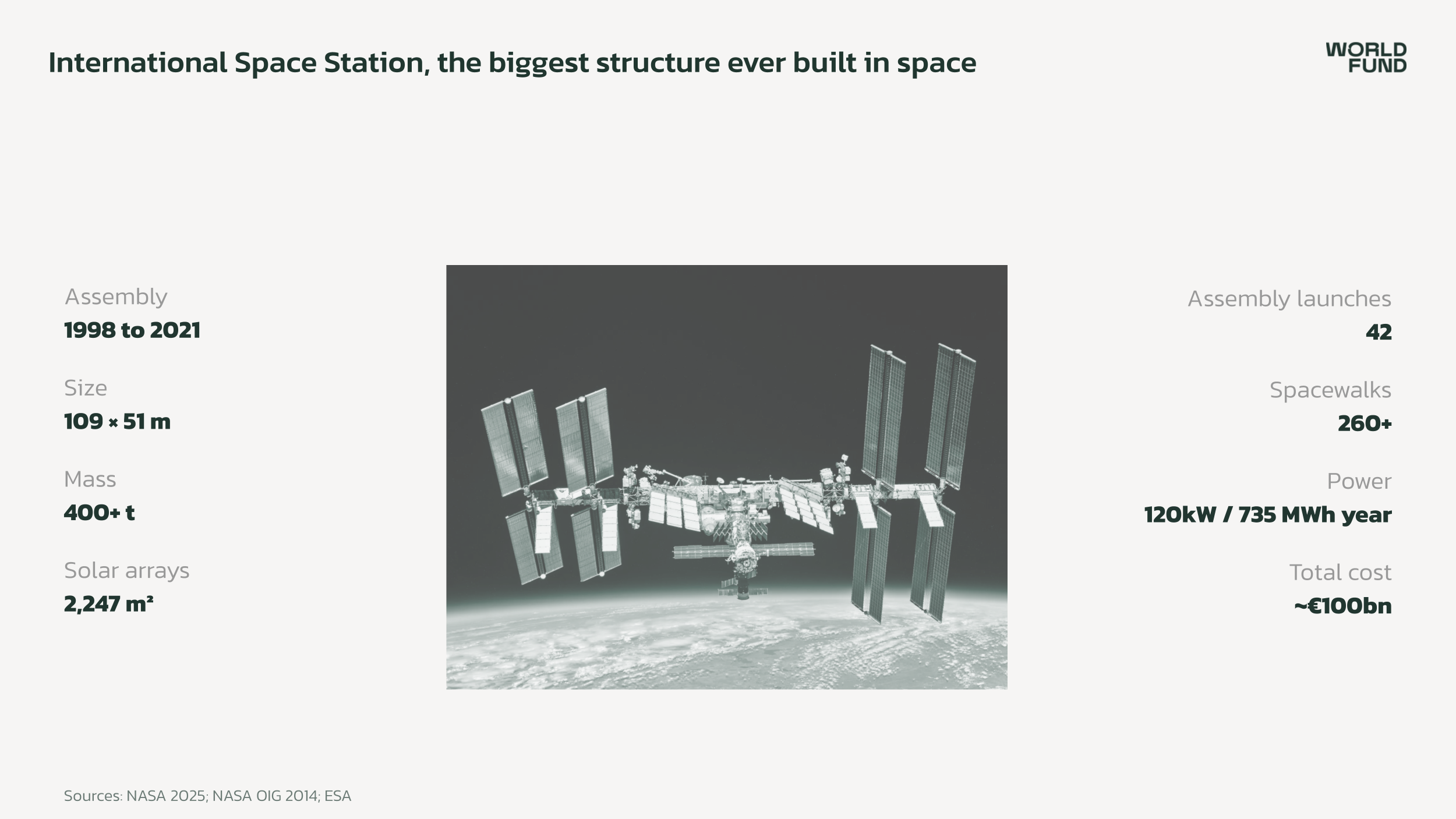
Figure 5: International Space Station, the biggest structure ever built in space (Sources: World Fund analysis based on NASA, NASA OIG (2014), ESA, NASA OTPS (2024)) 

Until an integrated demonstration delivers sustained power from orbit with measured end-to-end efficiency, the economics of commercial SBSP remain theoretical 

Can Europe shape the future of SBSP

For Europe, SBSP is a question of strategic autonomy. ESA's SOLARIS programme has investigated its technical and economic feasibility, while European industry already has expertise in space photovoltaics, deployable structures and satellite engineering.

Other regions are moving towards demonstrations. The US combines private investment with defence-backed research, while China has proposed orbital tests and Japan continues to develop wireless power transmission. Europe has much of the technical foundation, but still faces a funding gap between research and commercial deployment.

This requires more than developing individual components. The ability to integrate solar arrays, wireless transmission, orbital structures, and ground infrastructure will be critical. Moving from research to orbital demonstrations will also require public funding and established industrial partners, as venture capital alone is unlikely to finance the earliest large-scale projects.

Where we see the opportunity

At World Fund, we believe SBSP must prove it can be a business in low Earth orbit (LEO) before any plan to move to massive structures in GEO. We look for companies that build world-class hardware, understand how energy is bought and sold, and can navigate a highly specialised aerospace ecosystem.

We need to see credible commercial demand, ideally through a priced agreement or paid pilot. Their cost models must account for realistic launch access, system mass, transmission efficiency, and the price customers are willing to pay. 

We remain cautious about projects requiring billions in capital before their first sale and components whose commercial opportunity depends entirely on SBSP succeeding. Large pre-commercial demonstrations may require public funding and established industrial partners rather than venture capital alone.
Power from orbit is a big opportunity with many assumptions that need to materialise for it to be successful. The ones listed in this article are the ones we should consider before getting excited. 

The bottom line

The question for space-based solar power is no longer whether it can be imagined, or even launched. It is whether every link in the chain can work at the same time: launch at $500/kg or less; solar arrays that are far lighter and cheaper; beams steered precisely at scale; at least a third of the power reaching the ground; assembly in orbit that runs itself; and land and spectrum on the ground. Each link has advanced on its own, but none has been shown working together, and today’s best cost estimates still put power from orbit above the price of diesel at a remote military base.

The first winners will close that gap with a smaller system in LEO that delivers measured power to a customer with no better option, long before anyone builds a gigawatt plant in GEO. The company that does this first will have turned a 60-year-old idea into an energy business. It will also be well placed to compete for the far larger market of data centres and grid-constrained sites.

If you are working on any link in this chain, or on finding the first paying customer, and you have results you can measure, please get in touch at robin@worldfund.vc and craig@worldfund.vc.

No items found.

Deep dive: World Fund and Katapult VC on seaweed as an essential climate solution

Read more

Why We Invested in Lithosquare: Completing the energy transition will require vast amounts of mineral resources

Read more

White Paper: Green Computing in the AI era

Read more