.svg)
.svg)


Beyond the Drill: How Biology Is Reshaping the Mining Industry
.svg)
.svg)
Biology is poised to unlock the critical minerals the energy transition needs, without relying on new mines.
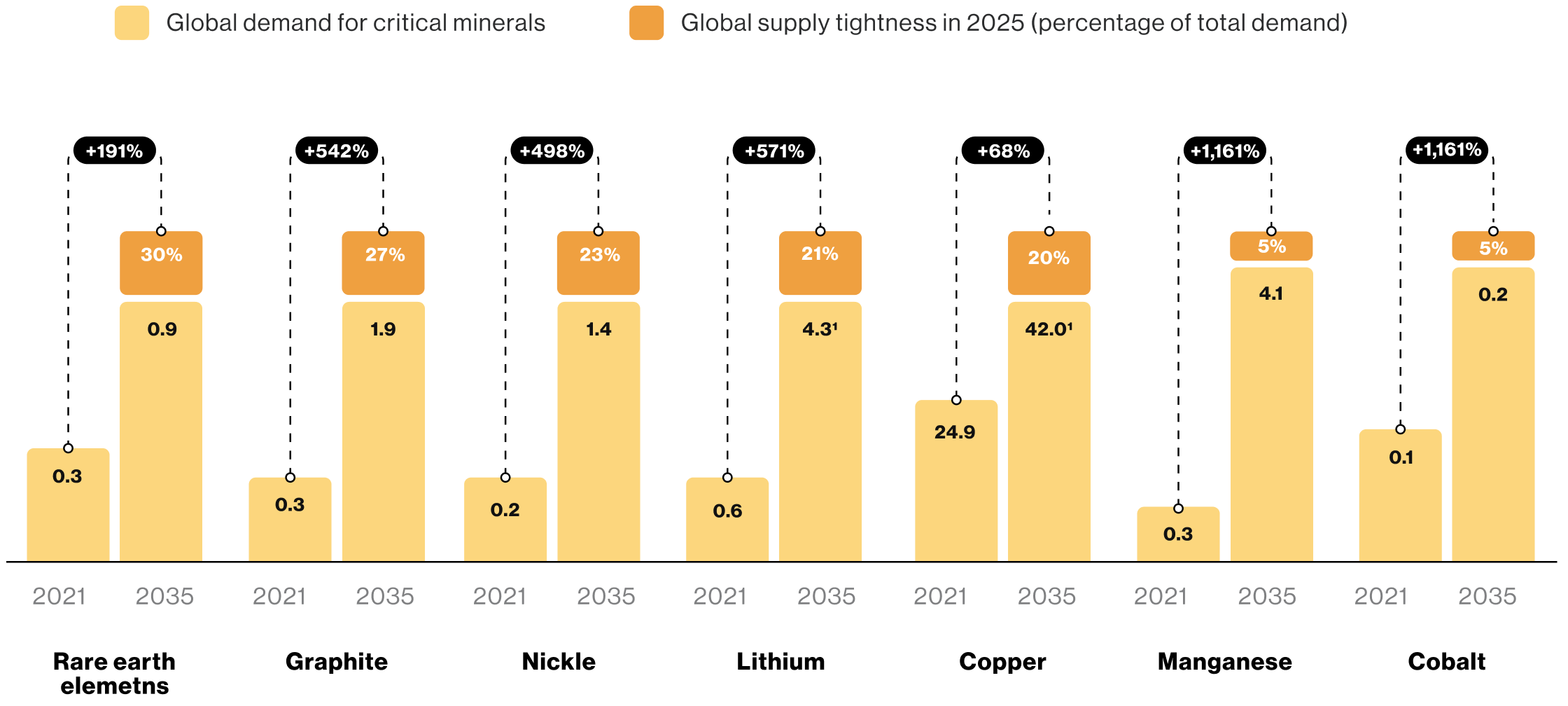
The mining industry is approaching a structural inflection point. Demand for critical minerals is accelerating, driven by electrification, grid expansion, battery manufacturing, and the rapid build-out of data centre infrastructure.
At the same time, the constraints of conventional mining are intensifying. Ore grades are declining, energy and water requirements per tonne are rising and exploration spending has fallen. At the same time, new discoveries are becoming rarer and deeper and permitting timelines continue to lengthen. By 2035, a 20% gap is expected between critical mineral demand and identified supply. The industry urgently needs new extraction pathways capable of unlocking resources that are currently uneconomic or inaccessible, while minimising exploration emissions and environmental damage.
Enter biomining. Biomining introduces a fundamentally different approach. Rather than relying primarily on heat, pressure, and chemical reagents, it leverages biological systems – microorganisms, engineered proteins, plants, and fungi – to mobilise, concentrate, or selectively bind metals. This creates a potential pathway to improve recovery, reduce chemical intensity, and access lower-grade or previously stranded resources.
The transition is already underway. Bioleaching now underpins a growing share of global copper production, Rio Tinto's Nuton venture has demonstrated recoveries of up to ~85% on primary sulphide ores, and phytomining companies like Genomines are advancing from pilot programs toward commercial-scale nickel extraction. Between 2010 and 2025, mining startups raised $3.5 billion, with activity accelerating sharply since 2015.

This report - produced by Nucleus Capital, Bidra Innovation Ventures, Forbion BioEconomy and World Fund - examines the technological landscape, commercial potential, and key considerations for investors and operators evaluating biomining opportunities today.
"Biomining technologies are not competing head-on with the most productive conventional mines. They unlock value in resource segments that are currently uneconomic - and that changes the calculus entirely."
– Nadine Geiser, Principal, World Fund
Full report available here: Link

.jpg)


.svg)
.svg)
.svg)