Knowledge

Materials Discovery at Machine Speed
Materials discovery at machine speed: where the European opportunity lies

We cannot build the energy transition without new materials, and we have never been able to find them fast enough. The way we discover them has barely changed in 70 years: hypothesise a candidate, synthesise it, test it, watch it fail, and start again. From first idea to a material that actually ships takes a decade at the very least. For new battery materials, often 10 to 15 years, and no faster for semiconductors or catalysts. Much of what modern industry runs on was found by accident. Teflon came out of a failed refrigerant experiment in 1938, and the lithium-ion cathode that powers the device you are reading this on owes as much to luck as to design.

That is a fragile way to source the inputs of an industrial economy, and the scale explains why. There are an estimated 10¹⁴⁰ possible material combinations, more than the number of atoms in the observable universe, and we have explored a vanishingly small corner of it. The materials we are still missing, solid-state battery electrolytes, rare-earth-free magnets, ruthenium-free catalysts and PFAS-free polymers - are precisely the ones the transition depends on. The materials bottleneck is a climate bottleneck. What has changed is that, for the first time, the tools to attack it have crossed a usability threshold.

Why is it possible now?

The turning point was 2020, when AlphaFold showed that an AI model could solve a fundamental scientific problem that had resisted decades of effort. Materials followed quickly: M3GNet in 2022, DeepMind's GNoME in 2023, Microsoft's MatterGen and Meta's OMat24 in 2024. These models learned to simulate how atoms behave well enough to predict whether a material will be stable, layered on top of two decades of open infrastructure like the Materials Project.

However, most predicted materials are still not directly usable. A structure may look stable in simulation but be impossible to synthesise, rely on inaccessible inputs, or fail under real operating conditions. The new AI era, however, makes it far more feasible to incorporate these critical considerations and performance characteristics into the selection of suitable materials. AI for science has become the trend every major lab is chasing, from Anthropic to Mistral, with the promise of compressing discovery from 10 to 20 years down to 2 to 5. At the same time, enterprise R&D budgets opened a dedicated line for AI-materials work, and Europe's supply-chain exposure made the sovereignty argument impossible to wave away.

Where the demand sits

Five verticals carry most of the value. Semiconductors are the largest, poised to reach a $1 trillion market by 2030, as incumbent materials start to fail below 3nm. Green steel is a roughly $900 billion market where fifty years of alloy databases are being made obsolete by the shift to direct-reduced iron. Batteries, $150 billion by 2030, still have no commercially proven solid-state electrolyte. Catalysis, at $37 billion, holds one of the largest decarbonisation levers available, yet there is still no viable replacement for scarce, China-controlled ruthenium. Polymers, at $12 billion, are also vital due to pressures such as the proposed EU PFAS ban with no direct replacement for most uses.

AI compresses the middle of discovery, not the finish line

It helps to be precise about what AI does. It compresses the middle of discovery, not the whole. Picture a funnel starting from 10¹⁴⁰ candidates: computational screening narrows millions to thousands, an active learning loop takes thousands to hundreds, lab validation cuts those to a handful, and scale-up turns them into the one to three products that actually ship. AI bites hard at the top and barely at the bottom, where qualification still takes three to five years. The compression is real, with shortlisting that once took three to five years and 500-plus experiments now taking three to six months and 50 to 100, while exploring far more of the space.

That speed comes with a catch that the best teams take seriously: the gap between simulation and reality. GNoME predicted 2.2 million stable crystals, yet only around 700 have been validated in a lab, and a structure stable at absolute zero is not yet a material you can make. This draws the real dividing line in the field. A company that can run experiments closes the loop between prediction and result and becomes a discovery engine. A company that cannot, will be a screening tool, however good its software.

If the models are open source and the data is public, what is the moat?

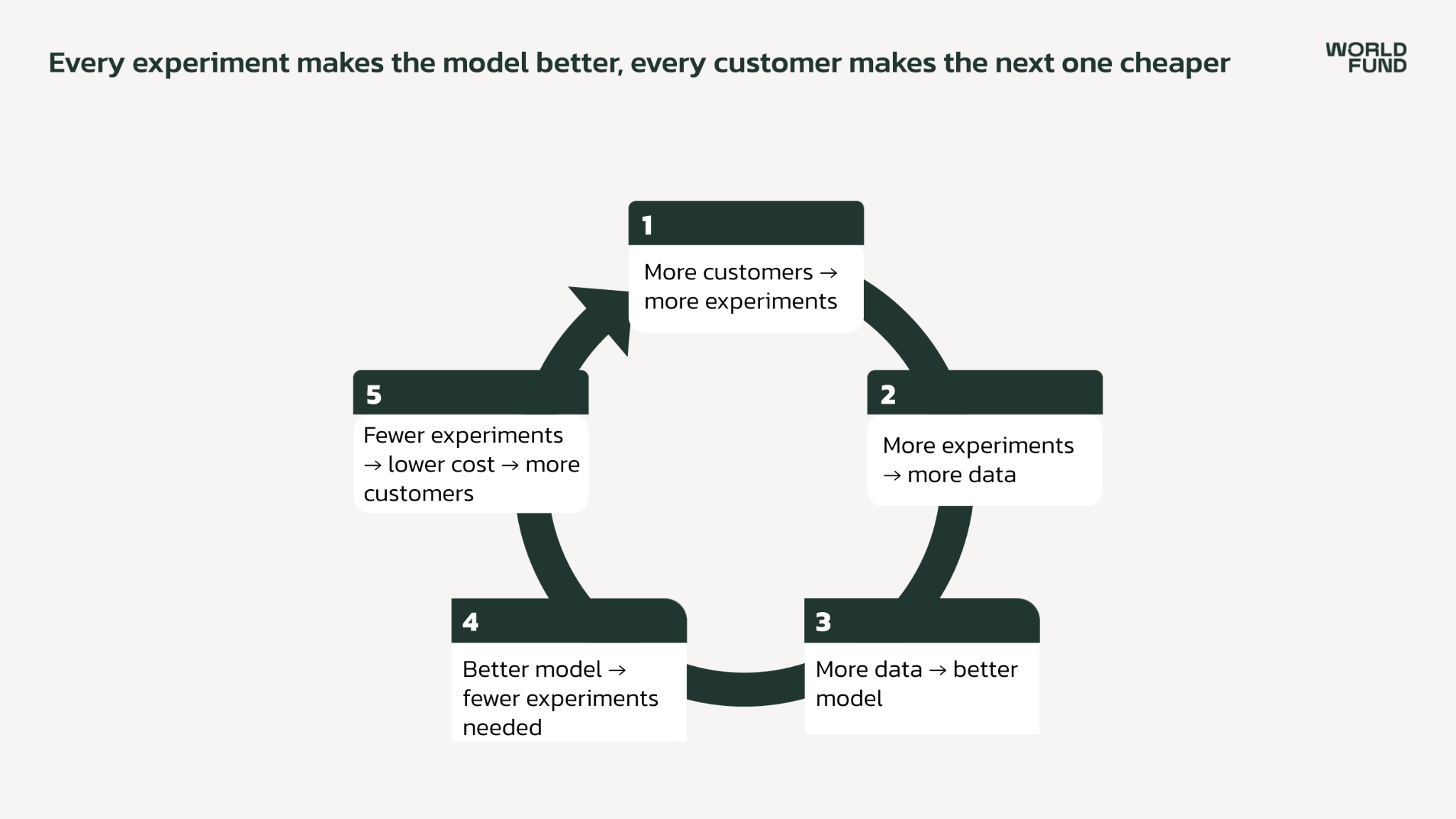
This is the question the whole sector turns on. The leading interatomic potentials are open source and the big training databases are public, so everyone trains on the same data and clusters around the same inorganic crystalline materials. If your inputs are free, so is your moat. The durable advantage is proprietary experimental data, generated in your own lab and structured so that synthesis, structure and properties are linked rather than just piled up. That data compounds while models commoditise.

Where value lands depends on how far a company travels along a second axis, from pure software, to software plus lab feedback, to owning materials IP, to full vertical integration where it discovers, makes and sells the material itself. Software alone has high margins and almost no defensibility. The further right you go, the more durable the business and the harder it is to scale. Two open questions sit underneath this. Many companies promise pharma-style royalties once they discover a winning material, but that model is unproven for what may turn out to be commodity materials, and customers resist paying in perpetuity. And a fully autonomous lab is as hard and expensive to build as the AI, which raises a real question for Europe: can a company raise enough to attempt it, or is the smarter bet a team of excellent lab technicians generating the same data for far less capital? One thing is clear locally: industrial customers will not put their formulations on a US cloud, so on-premise deployment is a requirement.

The US is building valuations. Europe is building businesses

The contrast is stark. The most-funded US players carry huge valuations on near-zero revenue. Periodic Labs is reportedly in talks to raise around $500 million at a €7.5 billion valuation, betting that the biggest proprietary database wins, even as half its experiments still fail. And Schrödinger, the computational gold standard for two decades, now trades ~80% below its 2021 peak. Being first and technically excellent isn't enough without owning the outcome.

Europe is quieter and cheaper, but also a place to build real businesses. Entalpic (France) and Dunia (Germany) are both pushing the lab thesis hardest to validate their AI predictions at industrial scale. PhaseTree (Denmark), Orbital Industries (UK) and CuspAI (UK) are further top candidates from Europe.

What we look for

Removing the materials bottleneck is a precondition for the energy transition, not an accelerator of something that would happen anyway. The strongest climate cases include ruthenium-free ammonia catalysts that directly address nearly 500 million tonnes of annual CO₂, and longer-lasting batteries that avoid a full cycle of mining, refining, and manufacturing.

At World Fund, we believe the company is worth backing if it bridges computation and experiment under commercially relevant conditions, owns its IP, and is already moving toward vertical integration, with genuine European market fit, capital efficiency, and a world-class scientist paired with a real operator. We avoid pure simulation with no lab, services dressed up as a platform, and pre-revenue companies at billion-dollar valuations. 

We admit that we do not yet know whether materials-IP licensing works at scale or how long the pilot trap lasts. But the prize is clear. When Merck bought Versum Materials and its ALD precursor chemistry for $6.5 billion in 2019, it showed what a strategic buyer will pay to own a critical material.

The breakthrough we are watching for is the European company that turns a real proprietary-data advantage into materials it owns, in a vertical where demand already exists. We have not yet found the one that clears every bar, but we are actively looking. If you are building in this space, please get in touch.

About the authors: Ophélie Laurin is an Investment Associate at World Fund and Nadine Geiser is a Principal at World Fund. They led World Fund's deep dive into AI for materials discovery. Craig Douglas, Founding Partner at World Fund, was the reviewer.

You can reach them at ophelie@worldfund.vc, nadine@worldfund.vc and craig@worldfund.vc

Dr. Nadine Geiser, World Fund

Principal

nadine@worldfund.vc

Craig Douglas, World Fund

Partner

craig@worldfund.vc

Ophélie Laurin, World Fund

Investment Associate

ophelie@worldfund.vc

July 16, 2026

Europe’s state of climate VC — Slides for Planet Sustainability

Read more

Why We Invested in Hyperscale Power: Electrification and compute needs are scaling faster than the power infrastructure beneath them.

Read more

Fueling the future bioeconomy: funding and deep tech innovation at the Bioinnovation Institute 

Read more
Knowledge

Materials Discovery at Machine Speed

|
White Paper

Materials discovery at machine speed: where the European opportunity lies

We cannot build the energy transition without new materials, and we have never been able to find them fast enough. The way we discover them has barely changed in 70 years: hypothesise a candidate, synthesise it, test it, watch it fail, and start again. From first idea to a material that actually ships takes a decade at the very least. For new battery materials, often 10 to 15 years, and no faster for semiconductors or catalysts. Much of what modern industry runs on was found by accident. Teflon came out of a failed refrigerant experiment in 1938, and the lithium-ion cathode that powers the device you are reading this on owes as much to luck as to design.

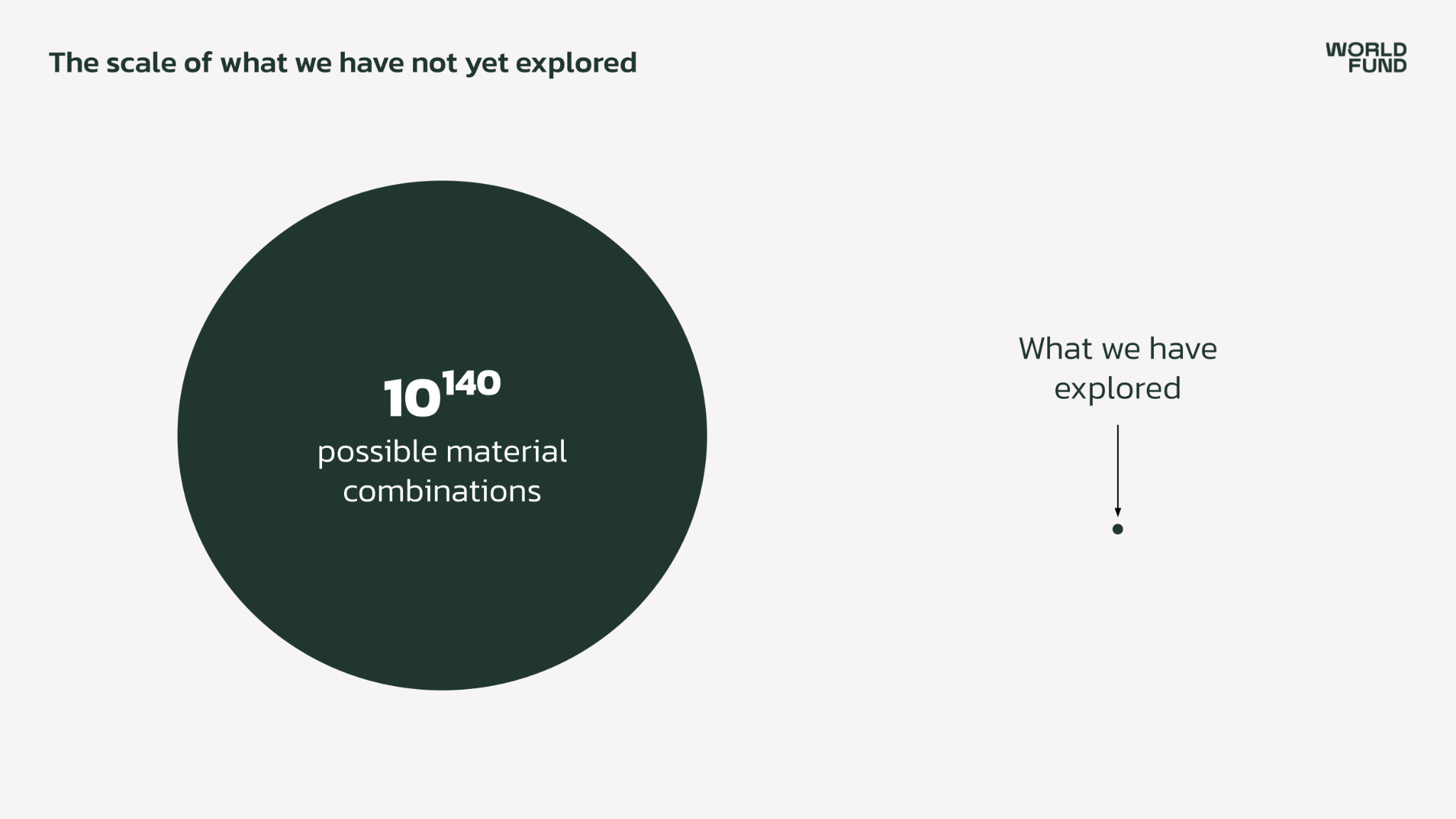
That is a fragile way to source the inputs of an industrial economy, and the scale explains why. There are an estimated 10¹⁴⁰ possible material combinations, more than the number of atoms in the observable universe, and we have explored a vanishingly small corner of it. The materials we are still missing, solid-state battery electrolytes, rare-earth-free magnets, ruthenium-free catalysts and PFAS-free polymers - are precisely the ones the transition depends on. The materials bottleneck is a climate bottleneck. What has changed is that, for the first time, the tools to attack it have crossed a usability threshold.
Why is it possible now?

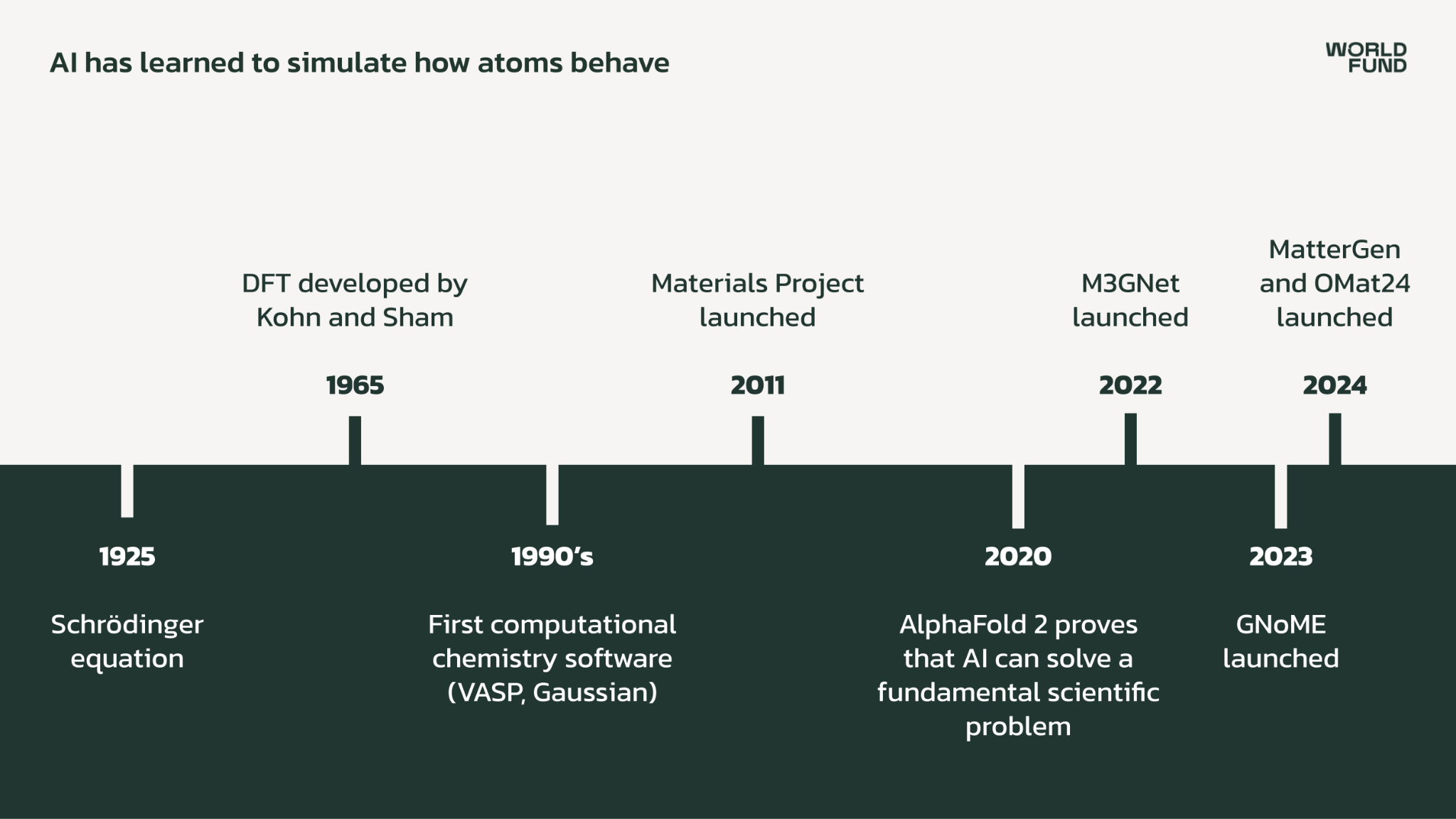
The turning point was 2020, when AlphaFold showed that an AI model could solve a fundamental scientific problem that had resisted decades of effort. Materials followed quickly: M3GNet in 2022, DeepMind's GNoME in 2023, Microsoft's MatterGen and Meta's OMat24 in 2024. These models learned to simulate how atoms behave well enough to predict whether a material will be stable, layered on top of two decades of open infrastructure like the Materials Project.
However, most predicted materials are still not directly usable. A structure may look stable in simulation but be impossible to synthesise, rely on inaccessible inputs, or fail under real operating conditions. The new AI era, however, makes it far more feasible to incorporate these critical considerations and performance characteristics into the selection of suitable materials. AI for science has become the trend every major lab is chasing, from Anthropic to Mistral, with the promise of compressing discovery from 10 to 20 years down to 2 to 5. At the same time, enterprise R&D budgets opened a dedicated line for AI-materials work, and Europe's supply-chain exposure made the sovereignty argument impossible to wave away.

Where the demand sits

Five verticals carry most of the value. Semiconductors are the largest, poised to reach a $1 trillion market by 2030, as incumbent materials start to fail below 3nm. Green steel is a roughly $900 billion market where fifty years of alloy databases are being made obsolete by the shift to direct-reduced iron. Batteries, $150 billion by 2030, still have no commercially proven solid-state electrolyte. Catalysis, at $37 billion, holds one of the largest decarbonisation levers available, yet there is still no viable replacement for scarce, China-controlled ruthenium. Polymers, at $12 billion, are also vital due to pressures such as the proposed EU PFAS ban with no direct replacement for most uses.

AI compresses the middle of discovery, not the finish line

It helps to be precise about what AI does. It compresses the middle of discovery, not the whole. Picture a funnel starting from 10¹⁴⁰ candidates: computational screening narrows millions to thousands, an active learning loop takes thousands to hundreds, lab validation cuts those to a handful, and scale-up turns them into the one to three products that actually ship. AI bites hard at the top and barely at the bottom, where qualification still takes three to five years. The compression is real, with shortlisting that once took three to five years and 500-plus experiments now taking three to six months and 50 to 100, while exploring far more of the space.

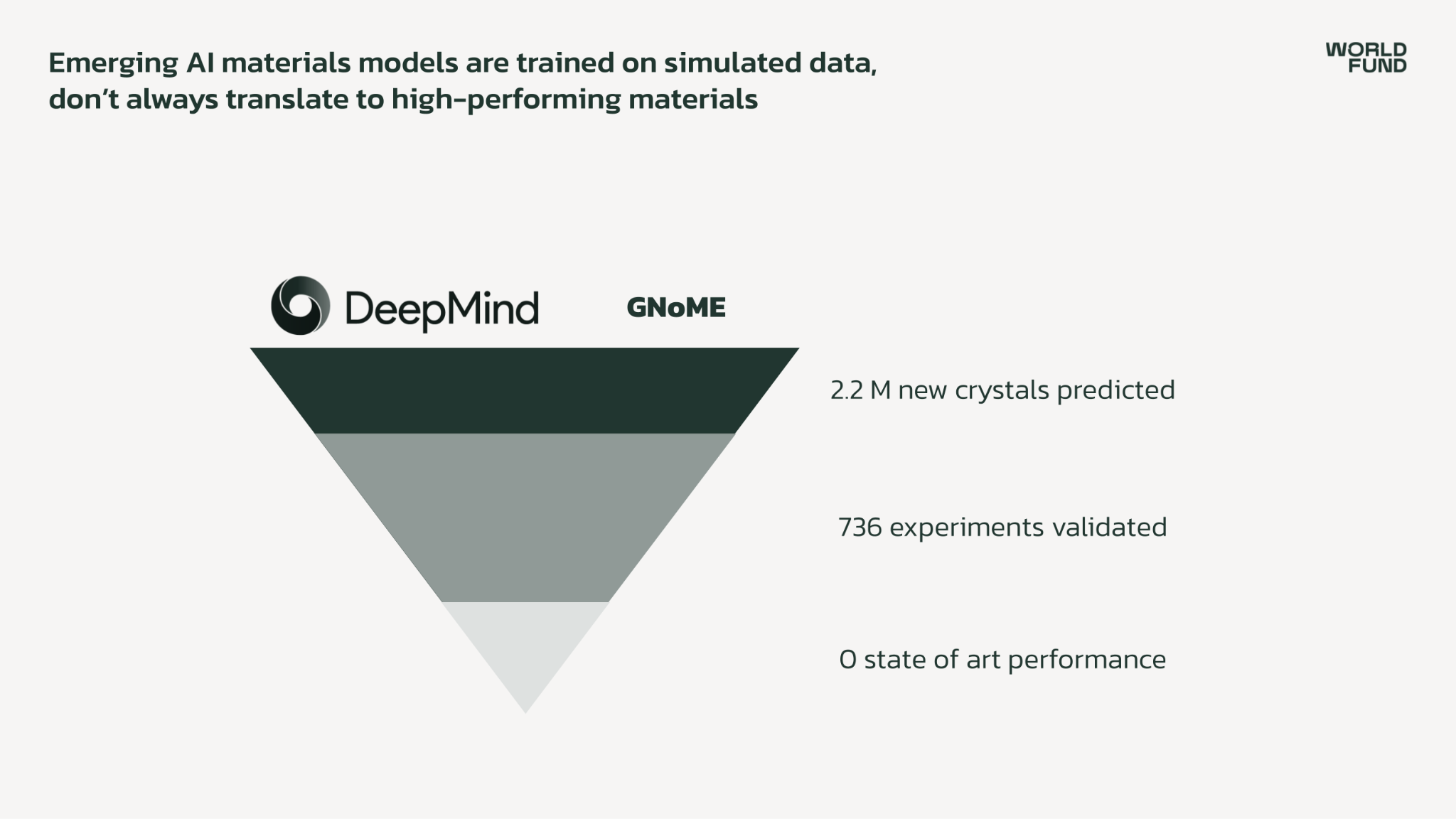
That speed comes with a catch that the best teams take seriously: the gap between simulation and reality. GNoME predicted 2.2 million stable crystals, yet only around 700 have been validated in a lab, and a structure stable at absolute zero is not yet a material you can make. This draws the real dividing line in the field. A company that can run experiments closes the loop between prediction and result and becomes a discovery engine. A company that cannot, will be a screening tool, however good its software.
If the models are open source and the data is public, what is the moat?

This is the question the whole sector turns on. The leading interatomic potentials are open source and the big training databases are public, so everyone trains on the same data and clusters around the same inorganic crystalline materials. If your inputs are free, so is your moat. The durable advantage is proprietary experimental data, generated in your own lab and structured so that synthesis, structure and properties are linked rather than just piled up. That data compounds while models commoditise.

Where value lands depends on how far a company travels along a second axis, from pure software, to software plus lab feedback, to owning materials IP, to full vertical integration where it discovers, makes and sells the material itself. Software alone has high margins and almost no defensibility. The further right you go, the more durable the business and the harder it is to scale. Two open questions sit underneath this. Many companies promise pharma-style royalties once they discover a winning material, but that model is unproven for what may turn out to be commodity materials, and customers resist paying in perpetuity. And a fully autonomous lab is as hard and expensive to build as the AI, which raises a real question for Europe: can a company raise enough to attempt it, or is the smarter bet a team of excellent lab technicians generating the same data for far less capital? One thing is clear locally: industrial customers will not put their formulations on a US cloud, so on-premise deployment is a requirement.
The US is building valuations. Europe is building businesses

The contrast is stark. The most-funded US players carry huge valuations on near-zero revenue. Periodic Labs is reportedly in talks to raise around $500 million at a €7.5 billion valuation, betting that the biggest proprietary database wins, even as half its experiments still fail. And Schrödinger, the computational gold standard for two decades, now trades ~80% below its 2021 peak. Being first and technically excellent isn't enough without owning the outcome.

Europe is quieter and cheaper, but also a place to build real businesses. Entalpic (France) and Dunia (Germany) are both pushing the lab thesis hardest to validate their AI predictions at industrial scale. PhaseTree (Denmark), Orbital Industries (UK) and CuspAI (UK) are further top candidates from Europe.

What we look for

Removing the materials bottleneck is a precondition for the energy transition, not an accelerator of something that would happen anyway. The strongest climate cases include ruthenium-free ammonia catalysts that directly address nearly 500 million tonnes of annual CO₂, and longer-lasting batteries that avoid a full cycle of mining, refining, and manufacturing.

At World Fund, we believe the company is worth backing if it bridges computation and experiment under commercially relevant conditions, owns its IP, and is already moving toward vertical integration, with genuine European market fit, capital efficiency, and a world-class scientist paired with a real operator. We avoid pure simulation with no lab, services dressed up as a platform, and pre-revenue companies at billion-dollar valuations. 

We admit that we do not yet know whether materials-IP licensing works at scale or how long the pilot trap lasts. But the prize is clear. When Merck bought Versum Materials and its ALD precursor chemistry for $6.5 billion in 2019, it showed what a strategic buyer will pay to own a critical material.

The breakthrough we are watching for is the European company that turns a real proprietary-data advantage into materials it owns, in a vertical where demand already exists. We have not yet found the one that clears every bar, but we are actively looking. If you are building in this space, please get in touch.

About the authors: Ophélie Laurin is an Investment Associate at World Fund and Nadine Geiser is a Principal at World Fund. They led World Fund's deep dive into AI for materials discovery. Craig Douglas, Founding Partner at World Fund, was the reviewer.

You can reach them at ophelie@worldfund.vc, nadine@worldfund.vc and craig@worldfund.vc

No items found.

White Paper: The Importance of Climate Tech for European Resilience

Read more

Why we invested in Enough – the world’s largest provider of sustainable protein

Read more

The state of: electrofuels for aviation

Read more