.svg)
.svg)


World Fund Impact Report 2025

.svg)
.svg)
The technologies rebuilding Europe
Our 2025 Impact Report is a portrait of the founders building companies in the trillion dollar sectors that will build Europe's competitive future. Full report available here.
Impact goes hand in hand with profit
These defining technologies are being built in reactors, recycling plants, and production hangars. They turn deep science into industrial scale. They have a massive potential for impact on the world economy, and they’re also some of the best financial bets in the market. At World Fund, that's not a happy accident, it's our thesis. Impact goes hand in hand with profit.
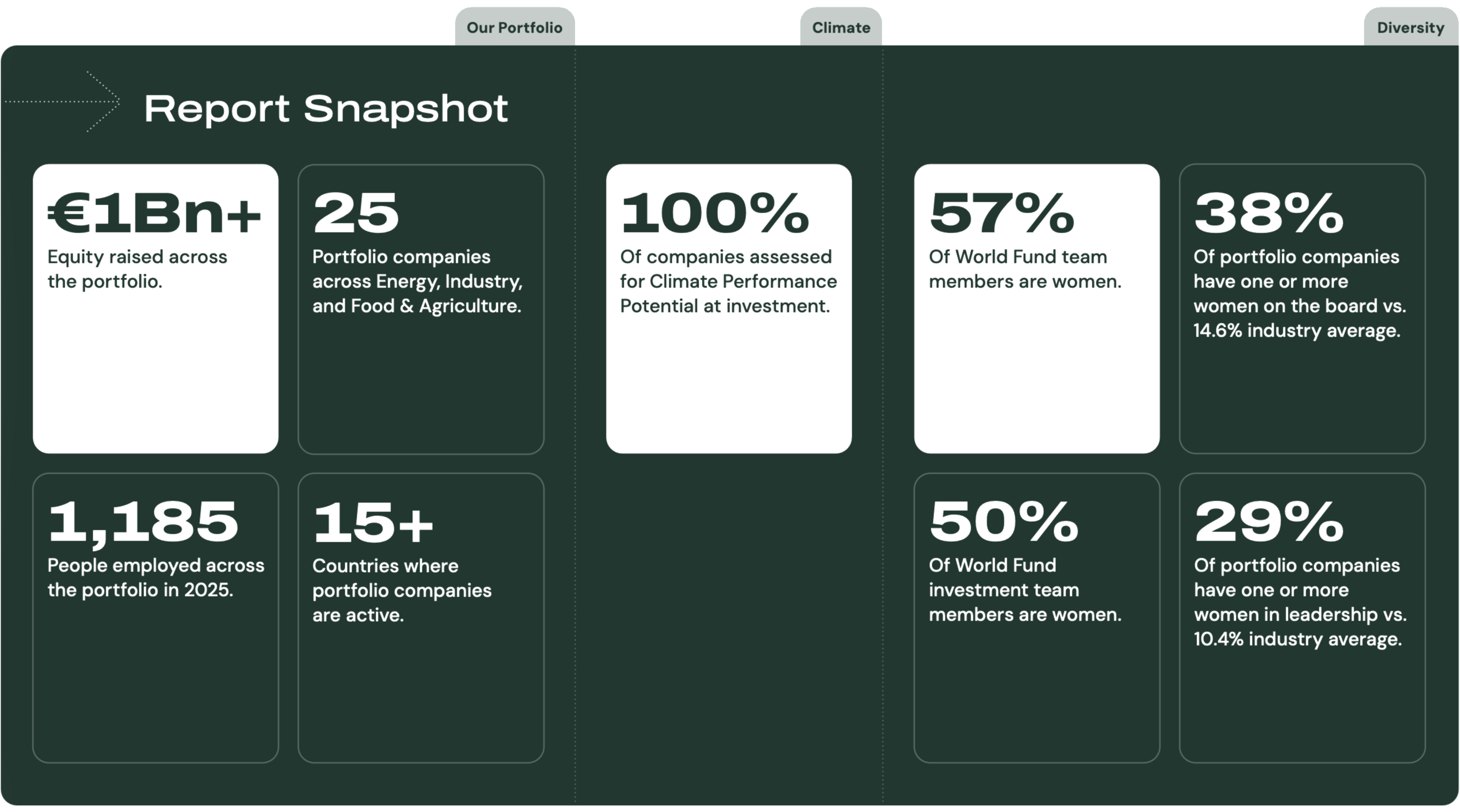
Our approach, with impact methodology at the heart of how we assess companies, helps us identify the technologies with the best financial and impact return. Across energy, industry, and food and agriculture, our portfolio spans 25 companies active in more than 15 countries, employing nearly 1,200 people and having raised over €1bn in equity.
Energy
In energy, our focus is a system that is cleaner, more modern, and less dependent on foreign supply. cylib is closing the loop on battery materials, preparing an industrial plant to recycle 140,000 EV batteries a year while recovering over 90% of critical materials at roughly 90% lower carbon than primary mining. enerkii is helping industrial and commercial sites switch to zero-emission on-site energy through an integrated Energy-as-a-Service model.
Industry
Industry is where deep science meets industrial scale. IQM has sold quantum computers to thirteen customers, including four of the world's top ten supercomputing centres, keeping a foundational technology in European hands. VÆRIDION moved from R&D into industrialisation in 2025, opening its first production hangar as it builds towards the first zero-emission regional flights. Space Forge is manufacturing ultra-pure semiconductors that cut energy losses by up to 75% in high-power applications, and ecoworks is delivering net-zero building renovations at scale through industrial prefabrication.
Food & Agriculture
In food and agriculture, we back companies making resilient, low-carbon supply chains commercially viable. In 2025, Planet A Foods scaled its cocoa-free ChoViva into more than 120 products across 10 countries and signed a partnership with Barry Callebaut, the world's largest chocolate manufacturer. Nitricity raised a $50M Series B for clean, renewable-powered fertiliser that is already sold out through 2028.
Portfolio Performance
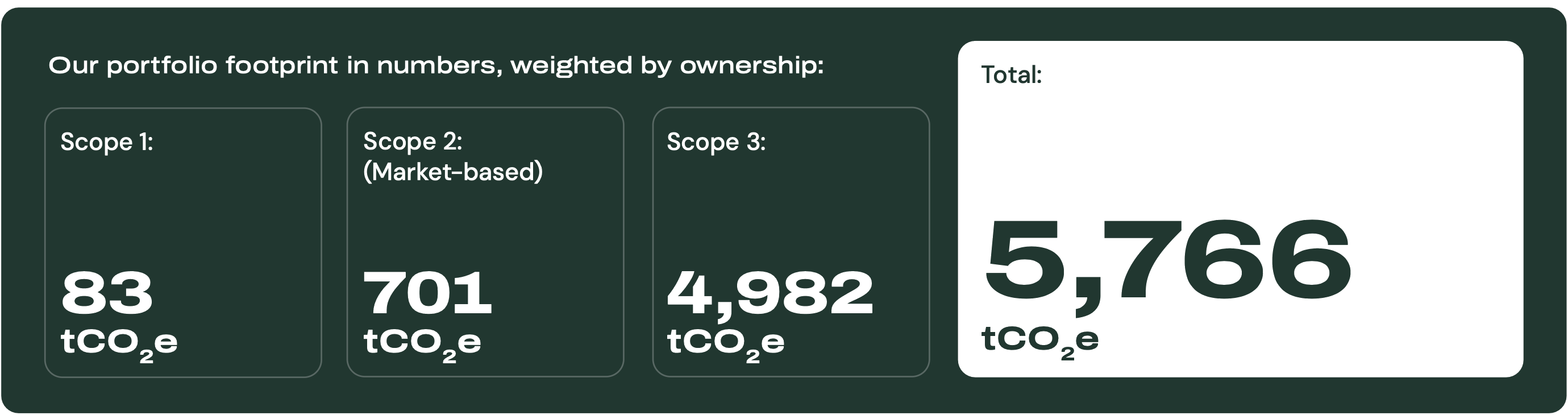
While decarbonisation is at the core of our portfolio companies' strategy, we use ESG metrics to understand company maturity over time. This includes benchmarking their carbon footprints and reducing CO2 emissions across scopes 1, 2, and 3, alongside broader environmental, social, and governance factors.
Read the report
This is what it looks like when impact goes hand in hand with profit, and why we believe the next decade of returns will be defined by those who backs these founders now.
Read the full 2025 Impact Report: Link here

.jpeg)



.svg)
.svg)
.svg)


-1.png)